
Indian manufacturing sector witnessed the fastest improvement in operating conditions in over 17 years in August, driven by an increased production efficiency and healthy demand conditions, a monthly report said on Monday. The seasonally adjusted HSBC India Manufacturing Purchasing Managers' Index (PMI) rose from 59.1 in July to 59.3 in August, indicating the fastest improvement in operating conditions for 17-and-a-half years.

A major fire near the main unit of the newly built Rajasthan refinery of HPCL has postponed the inauguration by Prime Minister Narendra Modi. The fire, which broke out near the crude distillation unit, was doused in about two hours with no reported casualties.
The headline HSBC India Purchasing Managers' Index -- a composite gauge designed to give a single-figure snapshot of manufacturing business conditions -- stood at 53.3 in November significantly higher from 51.6 in October.

Sluggish rise in new business inflows and a cautious approach to costs reportedly led Indian manufacturers to shed jobs in September.
India's manufacturing sector growth strengthened in July to a 16-month high of 59.1, supported by faster increases in new orders and output amid favourable demand conditions, a monthly survey said on Friday. The seasonally adjusted HSBC India Manufacturing Purchasing Managers' Index rose from 58.4 in June to 59.1 in July, signalling the strongest improvement in the health of the sector since March 2024.

The cost of the war is being counted not in the corridors of power in Washington or Tehran, but in Firozabad's darkened furnace rooms, Howrah's idle casting sheds, and a barbershop in Kochi where the wait is suddenly, inexplicably, an hour long, notes Prem Panicker in his must read blog on the Iran War.

'The West Asia or the Gulf crisis has shown that what we develop as national infrastructure when things are not as bad as they could be, we forget to plan for adversities.'

'My concern is that, although everything is expressed in monetary terms, you are effectively combining values that have been adjusted using different price measures.'

India's services sector growth moderated in December, as the rates of expansion in incoming new work and output eased to the slowest in 11 months, and companies refrained from recruiting additional staff, a monthly survey said on Tuesday. The seasonally adjusted HSBC India Services PMI Business Activity Index fell from 59.8 in November to 58.0 in December, indicating the slowest rate of expansion since January.

India's peak power demand is projected to hit 270 GW this summer, surpassing last year's record of 250 GW.

Tea planters in Darjeeling have raised that a shortage of commercial LPG, triggered by the ongoing conflict in West Asia, could hit tea processing during the first flush, the delicate early-season harvest that commands the highest premiums and often sets the tone for the year.

Base revisions are technical exercises, but history shows they can significantly reshape the narrative around India's growth performance.
India's industrial production growth slowed to 2.7 per cent in April 2025 due to poor performance of manufacturing, mining and power sectors, according to official data released on Wednesday.

When missiles fly in this region, they are never just aimed at military targets.

India's manufacturing sector growth fell to a three-month low in May, restricted by inflationary pressures, softer demand and heightened geopolitical conditions, a monthly survey said on Monday. The seasonally adjusted HSBC India Manufacturing Purchasing Managers' Index (PMI) fell from 58.2 in April to 57.6 in May, highlighting the weakest improvement in operating conditions since February.

India's industrial production growth slowed to a nine-month low of 1.2 per cent in May 2025 due to poor performance of manufacturing, mining and power sectors caused by the early onset of monsoon, according to official data released on mMonday. The factory output, measured in terms of the Index of Industrial Production (IIP), had expanded by 6.3 per cent in May 2024.

Any reduction on purifiers would need consensus among state finance ministers.

Iran is fighting a different war: Older, slower, and in some ways more dangerous. Iran doesn't need to shoot down an F/A-18. It only needs to make the Strait of Hormuz feel dangerous long enough for insurance markets, shipping companies, and oil futures traders to do the rest. Prem Panicker continues his must-read daily blog on the war in the Middle East.

'Given that the population is almost evenly split, the Indian economy cannot grow without women participating in the workforce.' 'While women's participation has increased, it is still well below 40 per cent,' says Kartik Narayan, CEO of the professional networking and jobs platform, Apna.
India's manufacturing sector activity eased to a nine-month low in November, mainly owing to softer rise in sales and production amid reports of challenging market conditions, a monthly report said on Monday. The seasonally adjusted HSBC India Manufacturing Purchasing Managers' Index (PMI) falling to 56.6 in November from 59.2 in October, highlighted the slowest improvement in operating conditions since February.

'Economic activity appears to have peaked in the second quarter of FY26, with industrial output, exports, and business confidence all softening from October 2025.'
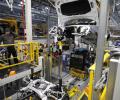
At an estimated 1.9 billion in losses and over 5,000 UK organisations affected, the Jaguar Land Rover cyberattack has been labelled the most economically damaging cyber incident in UK history, exposing the deep vulnerability of interconnected supply chains.
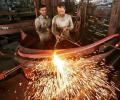
India's industrial production growth slows to 3.2 per cent in December 2024, mainly due to poor performance of mining and manufacturing sectors, according to official data released on Wednesday. The government has also revised the November 2024 IIP figure to 5 per cent from the provisional estimate of 5.2 per cent released in the previous month.

A host of macroeconomic data announcements, global trends and trading activity of foreign investors would dictate investors' sentiment in the stock market this week, analysts said. Besides, auto sales data will be closely tracked, experts noted.
India's services sector growth witnessed the slowest pace of expansion in five months in October, as competitive pressures and heavy rains in parts of the country led to a slower increase in output, according to a monthly survey released on Thursday.

Growth of eight key infrastructure sectors remained flat in October as expansion in output of petroleum refinery products, fertiliser and steel was offset by a contraction in coal and electricity production, according to official data released on Thursday.
India's industrial production growth accelerated to 5 per cent in January 2025, driven by a rebound in manufacturing activity, according to official data released on Wednesday.

'Grassroots-level corruption, which disrupts the last-mile work, cannot be ignored in your enthusiasm and drive to get going to complete the project.' 'Like it was in MGNREGA, in some states, it is the case with the Jal Jeevan mission.' 'The last minute levels of corruption can ruin the intent of the project itself.' 'When you see that people can game a particular well-intended and well-crafted project, you need to correct that.'

India's manufacturing sector growth rose to an eight-month high in March, driven by quicker increases in factory orders and production amid buoyant demand conditions, a monthly survey said on Wednesday. The seasonally adjusted HSBC India Manufacturing Purchasing Managers' Index (PMI) was at 58.1 in March, up from 56.3 in February, indicating a substantial improvement in the health of the sector that was above its long-run average. In February, India's manufacturing PMI fell to a 14-month low amid softer increase in new orders and production.

Prime Minister Narendra Modi on Friday said production linked incentive (PLI) scheme, which is aimed at boosting domestic manufacturing and exports, is expected to increase the country's production by $520 billion in the next five years. Addressing a webinar on PLI scheme, organised by Department of Industry and International Trade (DPIIT) and NITI Aayog, through video conference, Modi said the government is continuously carrying out reforms to boost domestic manufacturing. In this year's Budget, about Rs 2 lakh crore was earmarked for the PLI scheme for the next five years and "there is an expectation that the scheme would result in increasing the production by about $520 billion in the next five years", he said. He added that there is also an expectation that the current workforce in the sectors, which will avail the benefits of the PLI scheme, will be doubled and job creation will also increase.

High US tariffs are expected to affect close to 8 per cent of India's overall auto component production, ratings firm Icra said on Wednesday. Indian auto component exporters are at a relative disadvantage compared to most other Asian exporting nations, highlighting the importance of concluding an India-US bilateral trade agreement, it added.
India's manufacturing sector growth climbed to a 16-year high in March on the back of the strongest increase in output and new orders since October 2020, amid reports of buoyant demand conditions, a monthly survey said on Tuesday. The seasonally adjusted HSBC India Manufacturing Purchasing Managers' Index (PMI) surged to a 16-year high of 59.1 in March, from 56.9 in February, reflecting stronger growth of new orders, output and input stocks as well as renewed job creation. In Purchasing Managers' Index (PMI) parlance, a print above 50 means expansion while a score below 50 denotes contraction.

While many areas compete for resources, defence, education, and adaptation deserve focus for maximum impact, suggests Laveesh Bhandari.

Major foreign mining and refining companies have assured the Indian government that they will have sufficient stocks of rare-earth oxides to supply to the winning bidders under the country's production-linked incentive (PLI) scheme for indigenous manufacturing of rare-earth permanent magnets (REPMs), Business Standard has learnt.

The key question is how much of the latest growth record represents recovery from the 2020-2021 downturn, and what is the sustainable growth rate now, asks T N Ninan.

India's manufacturing sector growth started the year 2025 on a strong footing and touched a six-month high in January, fuelled by the steepest upturn in exports in nearly 14 years, a monthly survey said on Monday. The seasonally adjusted HSBC India Manufacturing Purchasing Managers' Index (PMI) rose from December's one-year low of 56.4 to 57.7 in January supported by the fastest upturn in new export orders since February 2011.

India's new national accounts will leverage new data sources and surveys to enhance the measurement of the country's informal economy, and introduce double deflation methods across sectors, replacing the current system that relies on a single deflation mechanism in Gross Domestic Product (GDP) calculations.
India's manufacturing sector growth fell to a 14-month low in February amid softer increase in new orders and production, a monthly survey said on Monday. The seasonally adjusted HSBC India Manufacturing Purchasing Managers' Index (PMI) registered 56.3 in February, down from 57.7 in January, but remained firmly within the 'expansionary' territory. In PMI parlance, a print above 50 means expansion, while a score below 50 denotes contraction.

The Indian services sector growth touched a 15-year high in August, driven by a sharp rise in new orders and output, amid substantial improvement in demand conditions, a monthly survey said on Wednesday. The seasonally adjusted HSBC India Services PMI Business Activity Index was up from 60.5 in July to 62.9 in August, indicating the steepest rate of expansion since June 2010.

The core dilemma remains: Why provide further stimulus to an economy that is already booming at an 8 per cent growth rate? asks Rajeswari Sengupta.
